
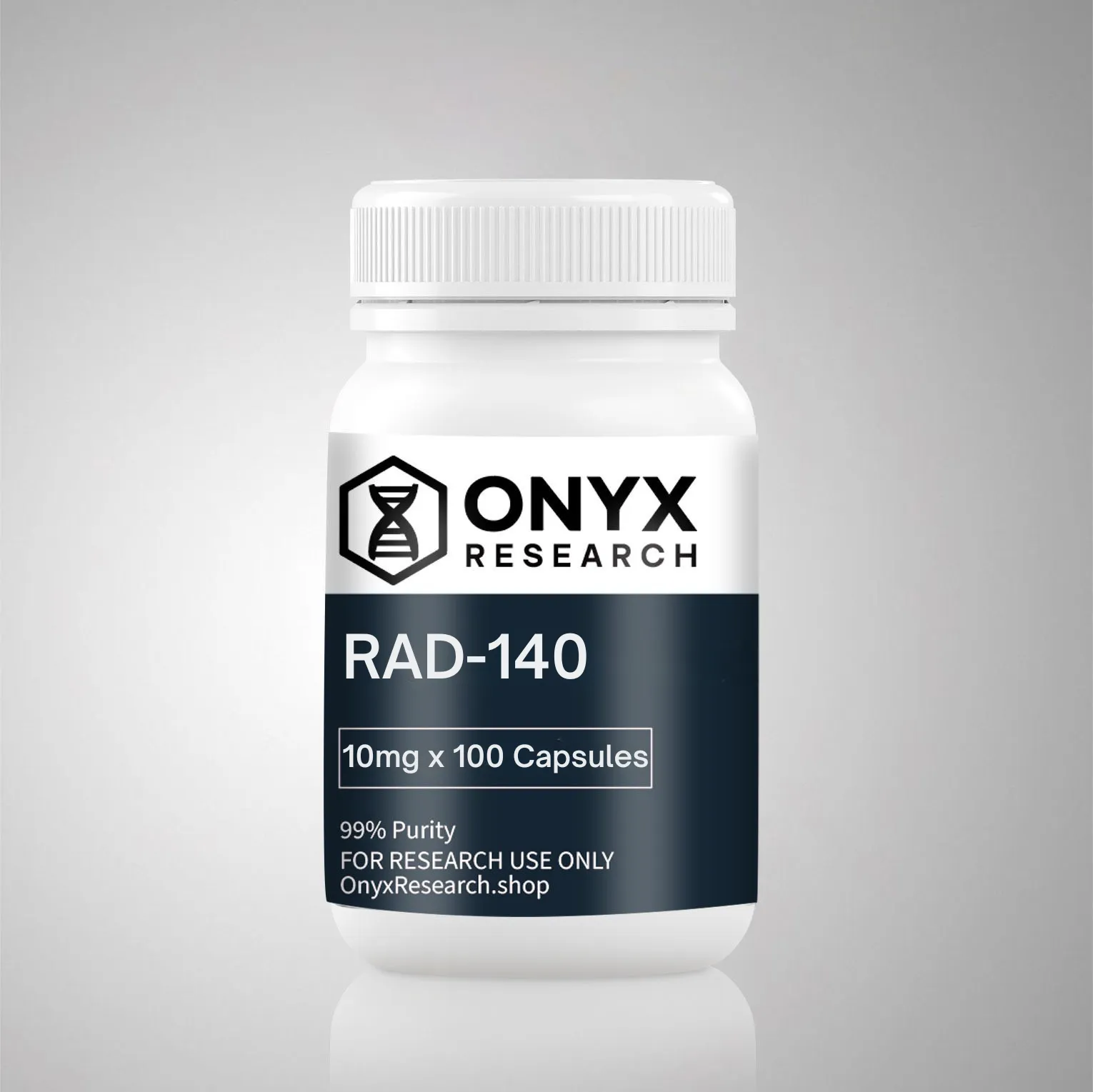
RAD-140
Original price was: $115.00.$89.00Current price is: $89.00.
RAD-140 10mg – 100 capsules for in vitro studies. Made in the USA. Testolone is a non-steroidal compound designed to interact selectively with androgen receptors (ARs)
Description
RAD-140 (Testolone): A Comprehensive Research Overview
Introduction to RAD-140
RAD-140 also known in scientific literature as Testolone is a selective androgen receptor modulator (SARM) that has attracted significant interest within biomedical and pharmacological research communities. Originally investigated for its potential role in treating muscle wasting and age-related degeneration, Testolone is studied primarily for its tissue-selective androgenic activity and favorable anabolic-to-androgenic ratio.
This article provides a research-oriented overview of Testolone, focusing on its chemical properties, mechanism of action, preclinical findings, safety considerations, and its place within ongoing experimental research. No clinical claims or consumer use guidance are implied.
Chemical and Pharmacological Background
Testolone is a non-steroidal compound designed to interact selectively with androgen receptors (ARs). Unlike traditional anabolic steroids, which broadly activate androgen receptors throughout the body, SARMs aim to provide targeted receptor activation in skeletal muscle and bone while limiting interaction with androgen-sensitive tissues such as the prostate or sebaceous glands.
From a chemical standpoint, Testolone demonstrates:
-
High binding affinity to androgen receptors
-
Structural stability suitable for oral bioavailability
-
Resistance to aromatization into estrogenic compounds
These properties make it an appealing compound for controlled laboratory studies investigating androgen signaling pathways.
Mechanism of Action
At the molecular level, Testolone binds to androgen receptors in muscle and bone tissue, triggering receptor conformational changes that promote gene transcription associated with protein synthesis and cellular growth. Unlike testosterone, which can convert into dihydrotestosterone (DHT) or estrogen, Testolone’s activity remains more localized.
Key mechanistic features include:
-
Selective receptor modulation
-
Activation of anabolic gene expression
-
Reduced interaction with non-target tissues
This selectivity is the primary reason RAD-140 has been explored as a candidate for conditions involving muscle loss without systemic androgenic overload.
Preclinical Research Findings
Most available data on Testolone comes from in vitro experiments and animal studies. In these controlled environments, researchers have observed:
-
Increased lean muscle mass in animal models
-
Improved bone mineral density markers
-
Limited stimulation of prostate tissue compared to testosterone
Additionally, some studies have investigated its neuroprotective potential, observing androgen receptor activity in neural tissues. While these findings are preliminary, they have opened additional research pathways beyond musculoskeletal applications.
It is important to emphasize that human clinical data remains limited, and current findings should not be extrapolated beyond experimental settings.
Research Applications and Experimental Use
In laboratory environments, Testolone is typically studied in the context of:
-
Muscle atrophy models
-
Age-related sarcopenia research
-
Hormone signaling pathway analysis
-
Comparative SARM efficacy studies
When researchers search for reference compounds, phrases such as BuyRAD-140 or RAD-140 for sale often appear in procurement-related contexts, referring to availability for laboratory experimentation rather than consumer use.
Safety Profile and Toxicology Considerations
From a research perspective, safety evaluation remains a central concern. Preclinical toxicology assessments have focused on:
-
Liver enzyme response
-
Endocrine suppression markers
-
Dose-dependent receptor saturation
Animal studies suggest that Testolone exhibits lower androgenic toxicity compared to anabolic steroids, though suppression of endogenous hormone production has been observed at higher dosages.
Long-term safety data is not yet established, reinforcing the importance of cautious handling and ethical research protocols.
Regulatory and Legal Research Context Buy RAD-140 oline
Globally, Testolone is classified as a research chemical and is not approved for therapeutic use. Regulatory agencies have not authorized it for medical treatment, dietary supplementation, or human consumption.
From an academic standpoint, searches such as Buy RAD-140 online generally reflect institutional sourcing inquiries rather than clinical application. Researchers must ensure that procurement aligns with institutional review standards and local regulations.
Comparison With Other SARMs
In comparative research, Testolone is often evaluated alongside compounds such as Ostarine (MK-2866) or Ligandrol (LGD-4033). Distinguishing characteristics include:
-
Higher androgen receptor affinity
-
Greater anabolic signaling intensity
-
Increased potency per milligram in animal models
These features make RAD-140 particularly useful for studies requiring strong receptor activation with minimal compound volume.
Ethical Considerations in Research
Ethical handling of SARMs is critical. Responsible research practice includes:
-
Clear labeling for laboratory use only
-
Secure storage and documentation
-
Avoidance of unauthorized human exposure
Mentions of RAD-140 for sale in scientific discourse should always be understood within a strictly controlled research supply context.
Analytical Methods and Detection RAD-140 for sale
Testolone can be quantified and analyzed using:
-
Liquid chromatography–mass spectrometry (LC-MS)
-
Gas chromatography (GC) methods
-
Receptor binding affinity assays
These methods allow researchers to monitor compound purity, stability, and metabolic breakdown during experimentation.
Future Research Directions
Ongoing scientific interest in Testolone centers on:
-
Long-term receptor selectivity
-
Combination studies with other modulators
-
Potential therapeutic index optimization
As research progresses, clearer insights into its risk–benefit profile may emerge, though clinical translation remains speculative at this stage.
Conclusion
RAD-140 represents a significant area of interest within androgen receptor research due to its selective activity and potent anabolic signaling in experimental models. While preclinical data suggests promising characteristics, its role remains confined to controlled laboratory research.
Search terms such as BuyRAD-140, Buy RAD-140 online, and RAD-140 for sale should always be interpreted in a research procurement context, not as an endorsement of non-regulated use.
Continued investigation, ethical oversight, and rigorous methodology will determine whether Testolone holds long-term scientific or therapeutic relevance.
Related products
-
Sale!
GLP1-SM 10mg
Original price was: $80.00.$70.00Current price is: $70.00. Add to cart -
Epithalon 10mg
$40.00 Add to cart -
Sale!
MK-677
Original price was: $115.00.$89.00Current price is: $89.00. Add to cart -
Sale!
Cagrilintide 1
Original price was: $110.00.$95.00Current price is: $95.00. Add to cart